Our engagement
IFP Training is committed to doing its utmost to welcome people with disabilities to our sessions, and to adapting our training courses to meet the specific needs of each learner.
If this proves impossible, IFP Training takes responsibility for helping them find the right training and structure.
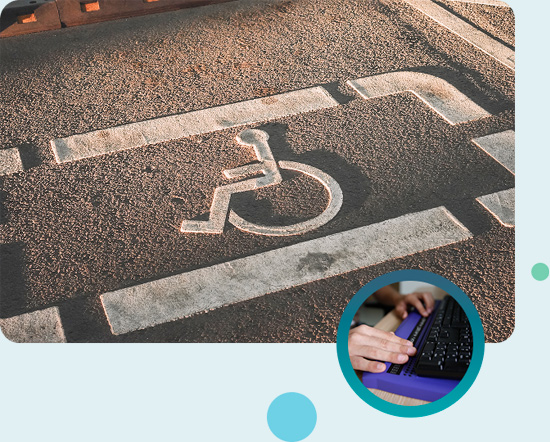
Our disability referent
He or she is your main point of contact when it comes to implementing the specific support or adjustments required to ensure that the training runs smoothly. He or she also ensures that learners can access training under the best possible conditions, in particular by taking into account their disability.
Throughout the session, the disability referent is attentive to the learner's needs, monitoring his or her progress and liaising with the company's various administrative departments. If necessary, he or she can refer the learner to other support structures with which he or she is in contact.
In addition, it undertakes to respect the confidential nature of exchanges with the learner and does not transmit any personal information without the learner's consent.

Welcoming people with disabilities
5 clearly defined stages
1
Joint assessment of the feasibility of training based on disability
If not possible, the disability referent and the training manager will refer the candidate to a partner (local employment agencies, MPSH).
2
Needs assessment
The learner's needs are assessed by the disability referent, with the assistance of various partners (AGEFIPH, employer) if necessary.
3
Adjustment of the learning path
Technical and educational adjustments to compensate for the disability are put in place; details are communicated to the teaching team. Follow-up is then carried out through regular check-ins.
4
Support during training
The disability referent ensures that the resources identified in steps 2 and 3 are properly implemented. If necessary, these resources are reassessed and adapted.
5
Assessments / Exams
Adaptation of assessment/testing methods CRFH website (Centre Ressource Formation Handicap) de réduire les coûts et de rendre la formation plus accessible.
Nos sessions interentreprises représentent donc une solution pratique pour développer les compétences de vos collaborateurs, tout en favorisant le partage de connaissances et l’enrichissement mutuel entre professionnels de différents secteurs.
Accessibility of our training courses for people with disabilities
To check whether our training courses are accessible to people with disabilities, please contact : [email protected]
Defining and recognizing disability
Disabilities include :

Activity Limitation
A person's participation in society as a result of a disabling health impairment, function or disorder.

Activity limitation in social life
Any limitation of activity in social life due to a substantial, permanent, or definitive impairment of one or more physical, sensory, mental, cognitive or psychological functions, a multiple disability, or an incapacitating health disorder.

Inability to live and act
The inability of a person to live and function in their environment due to physical, mental, or sensory impairments.
Partners in the handicap network
The association that manages the fund for the professional integration of people with disabilities helps companies in this area.
For more info, check out the websites for the sectors in our different locations :
- Lillebonne (Normandy)
- La Mède (Provence-Alpes-Côte d’Azur)
- Pau (New Aquitaine)
- Rueil-Malmaison (Ile-de-France)
- Solaize (Auvergne-Rhône-Alpes)
MDPH
Departmental Homes for People with Disabilities are dedicated to serving people with disabilities.
Disability and learning: what assistance is available?
To benefit from specific support under an apprenticeship contract, candidates must have signed their contract and be recognized as a disabled worker (RQTH), receive adult disability allowance (AAH), or hold a disability card. Under the RQTH scheme, apprenticeship contracts are available to candidates aged 16 and over, with no upper age limit.
Help with hiring
Assistance with hiring a person with a disability who has RQTH status or other type of recognition encourages employers to recruit and supports them in the process. This assistance can be combined with other AGEFIPH assistance and employment and professional integration assistance provided by the government. In addition, the assistance may be extended in the event of additional qualifications and is renewable in the event of preparation for a higher-level qualification.


Help for employers
Proportional to the duration of the employment contract. The maximum amount is €3,000.
AGEFIPH Assistance
They are not automatically available, and their issuance is not automatic. The application for work-study assistance must be submitted within three months of signing the contract. The AGEFIPH application form, duly completed and signed, must be accompanied by a bank account number and a copy of the signed apprenticeship contract.